Short Answer: What Each One Is Actually Good For
If you want the decision in one sentence: an automatic feeder wins on schedule precision and portion control; a timed bowl wins on price and simplicity — and the deciding factors are your pet’s health needs and how much you travel, not gadget love. If your pet needs exact portions (weight loss, diabetes, multiple small meals) or you’re regularly away 10–14 hours, automatic is worth the $40–$80. If you feed twice a day and are home most evenings, a $10–15 timed bowl does the same job for a quarter of the price.
This question sits high on every new cat and dog owner’s list because the two products look like competitors but solve different problems. Below is the honest breakdown: real costs over three years, accuracy and safety differences, and the situations where each one is objectively the wrong buy.
What They Are (And the Confusing Middle Ground)
A timed bowl (sometimes sold as a “timed feeder lid” or programmable bowl) is a mechanical or simple-electronic tray that opens at set times. It holds one or two pre-portioned meals, has no motor to jam and nothing to configure beyond the clock. Cost: typically $10–$25.
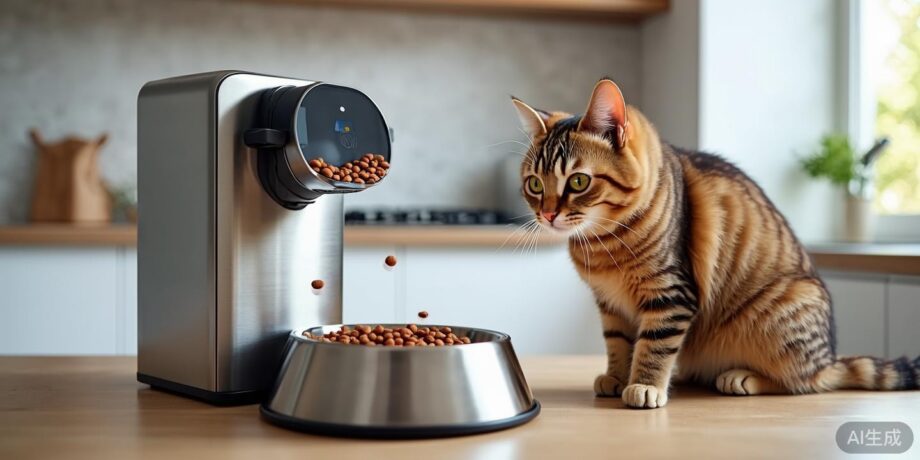
An automatic feeder is a hopper-based machine that stores 1–4 liters of dry food, dispenses programmable portions on a schedule, and — on smart models — adds app control, voice-recorded meal calls, battery backup, and cameras. Cost: typically $35–$90 for reliable models. This is the category our smart automatic cat feeder and the simpler automatic bowl feeder fall into.
The middle ground: gravity feeders (not timed at all — food just refills as the bowl empties). They’re cheap, but for pets who eat until the food is gone, a gravity feeder is a slow-feed bowl with extra steps and is best avoided for anyone controlling portions.
Cost Comparison: Purchase, Consumables, 3-Year Total
| Cost item | Timed bowl | Automatic feeder |
|---|---|---|
| Upfront | $10–$25 | $35–$90 |
| Batteries / power | $5–$10/year (AA cells) | $0–$5/year (USB power + backup batteries) |
| Replaceable parts | None | Desiccant bags ~$8/year to keep kibble crisp |
| Typical lifespan | 5+ years (almost nothing to break) | 2–4 years (motor, auger, sensors) |
| 3-year total | ~$40–$55 | ~$60–$130 |
Read the last row carefully: over three years the realistic gap is $30–$80, not the 5× the price tags suggest. The real difference is what happens on day 400, when a hopper motor starts slowing or kibble dust clogs the auger — a timed bowl has no day 400 problem.
Accuracy: Portions, Timing, and the Frozen Kibble Test
Where automatic feeders justify their price is precision:
- Portion accuracy: decent automatic feeders dispense within ±5–10% per meal across 1–10 portions per setting. Timed bowls are 100% accurate — you pre-scooped the meal yourself — but only for the meals you prepared in advance.
- Meal frequency: automatic feeders handle 4–6 small meals a day, which vets recommend for digestion, weight loss, and diabetic routine. A timed bowl tops out at the 1–2 chambers it has.
- Schedule drift: cheap timed bowls with analog dials can drift several minutes per week. Fine for dinner; not fine for a diabetic cat who needs insulin timed to food within ~30 minutes.
- Jam risk: automatic feeders can jam on oversized or sticky kibble (check the max kibble size before buying), and a jam means a missed meal. Timed bowls never jam, never lose power mid-dispense, and never need a firmware update.
Safety and Food Freshness
The failure modes differ, and it’s worth knowing them before choosing:
- Power loss: a timed bowl opens on a spring — power cuts don’t skip meals. Look for automatic feeders with battery backup (most mid-range models have it) and test it once by unplugging for a day.
- Food freshness: a sealed hopper with a desiccant keeps a week of kibble crisp; an open timed bowl exposes food to air, humidity, and ants, especially in summer. If you use a timed bowl, load it the same day, not three days ahead.
- Smart features: app-controlled feeders let you feed remotely and some record a meal call — genuinely useful for pets with separation anxiety or owners with shifting schedules. The trade-off is one more cloud dependency between your pet and dinner; models with local schedules + app override are the resilient choice.
- Multiple pets: neither device solves food stealing. If you have a dog that raids the cat’s bowl, the fix is placement (elevated or behind a gate), not a fancier feeder. A small barrier fence around the feeding station costs less than any feeder upgrade and works on every model.
Who Should Buy Which: Honest Recommendations
Choose the automatic feeder if:
- Your pet is on a vet-directed portion plan (weight loss, diabetes, GI issues) — the precision and 4–6 meal scheduling are the whole point.
- You’re regularly away 10–14 hours or work inconsistent shifts; the schedule runs itself.
- Meal-time anxiety or 5 a.m. wake-up meowing is a household problem — a consistent machine schedule retrains it faster than tired humans.
Choose the timed bowl if:
- You feed twice a day and are home for most of them; it’s a backup for late meetings, not a daily driver.
- Your pet is a vigorous chewer or plays rough with objects near the bowl — nothing on a timed bowl can break in a meaningful way.
- You want zero maintenance: no app, no desiccant, no auger to deep-clean monthly.
Skip both if: your pet free-feeds self-regulated kibble without weight issues — a plain pair of stainless bowls solved this decades ago and costs less than either option. And whatever you choose, put a mat underneath: feeders and bowls both scatter kibble, and a washable waterproof double-layer mat keeps the station a 10-second wipe instead of a daily sweep.
FAQ: Automatic Feeder vs Timed Bowl
Are automatic pet feeders worth it for cats?
For cats on portion-controlled or multi-meal schedules — weight management, diabetes, or owners away 10+ hours — yes, they’re one of the highest-satisfaction pet purchases going. For a single healthy cat whose owner is home twice a day, a $15 timed bowl or a plain bowl does the same job, and the honest answer is to save the money.
Can automatic feeders handle wet food?
Most cannot. Hopper augers are designed for dry kibble; wet food spoils in hours and clogs the mechanism. A few models ship with ice-pack trays for one or two wet meals — fine for a planned absence, not a lifestyle. Wet-food diets should stick to timed bowls with cooling packs or a pet sitter.
Do timed bowls work for dogs as well as cats?
For small to medium dogs, yes — check the chamber volume, since many timed bowls are sized for cat portions. Large-breed meals often exceed a single chamber, and a determined dog can flip a light bowl; anchoring it or choosing a weighted base solves that.
What happens to my pet’s meals if the power or Wi-Fi goes out?
Timed bowls: nothing, they’re mechanical. Automatic feeders with battery backup keep the schedule running; Wi-Fi-only features pause but locally stored schedules keep dispensing. Before buying any smart feeder, confirm it stores schedules on-device and has a battery compartment — then test both once a quarter.
Which is better for a diabetic pet?
An automatic feeder with proven portion accuracy and battery backup, paired with a regular schedule — diabetic cats and dogs need meals timed to insulin, and the ±5% portion consistency plus 4+ small meals a day is exactly what manual feeding struggles to deliver. Confirm your specific model’s accuracy with 10 test dispenses before relying on it.