
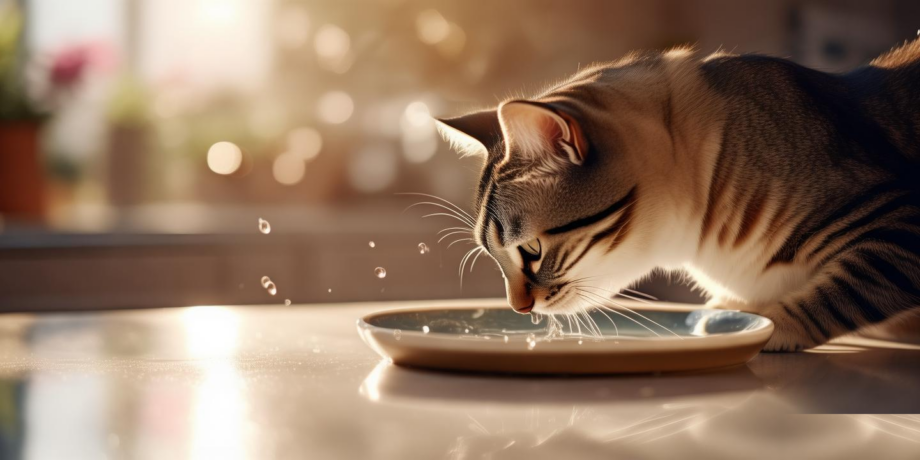
Most cats live mildly dehydrated and their owners never notice. Cats descend from desert hunters who pulled most of their moisture from prey, so the thirst drive that tells you to grab a glass of water is far weaker in cats — and a bowl of still water next to a food dish is the least tempting thing in the house to them. Getting a cat to drink more is rarely about nagging; it’s about rearranging a handful of small details so that drinking becomes the easy, appealing option. Here is what actually moves the needle, ranked roughly by impact.
Know How Much Water Your Cat Actually Needs
A cat needs roughly 3.5 to 4.5 ounces of water per 5 pounds of body weight per day, from all sources combined — food and bowl. A 10-pound cat therefore targets about 7 to 9 ounces daily. On dry kibble alone, nearly all of that must come from drinking, because kibble contains only about 10% moisture. A cat eating wet food, which runs 75–80% moisture, may need to drink almost nothing extra. This single dietary difference explains why two cats in the same home can have completely different drinking habits — and why “my cat never drinks” is often fine for a wet-food cat and a quiet problem for a kibble-fed one.
Move the Water Away From the Food Bowl
In the wild, a kill site and a water source don’t mix — prey fluids contaminate standing water, so cats carry an instinct to avoid drinking next to food or near where they eat. Many owners discover their cat barely touches the bowl sitting 8 inches from the kibble dish, then watches the same cat drain a glass left on a coffee table across the room. Try these placement fixes first, before spending anything on new gear:
- Separate rooms or several feet of distance between food and water — across the kitchen is better than across the corner.
- Multiple stations so water is never more than a short walk away; senior cats and kittens benefit most.
- Away from the litter box — cats avoid water that smells like waste sites, the same logic as the food rule.
- Quiet corners, not high-traffic hallways or next to a humming appliance like a washer.
This mirrors one of the most common first-time cat owner mistakes: assuming the cat sees the kitchen corner the way we see a dining table. Cats navigate the house by instinct maps, not by furniture layout.
Upgrade to a Ceramic or Glass Bowl
Plastic scratches microscopically, and those scratches hold bacteria that change how water smells and tastes — some cats develop chin acne from plastic bowls on top of drinking less. Steel is fine but some cats startle at the reflection or the tag-on-metal noise. Ceramic and glass stay smooth, keep water cooler longer, and don’t hold odors. Wash daily with hot water; a slimy biofilm forms within a day or two and cats can taste it even when you can’t see it. Wide, shallow dishes beat deep ones — whiskers are sensitive, and deep bowls press against them every time the cat drinks, a low-grade irritation many cats simply avoid by drinking less.
Try a Water Fountain — the Single Biggest Upgrade for Most Cats
Still water reads as stale to a cat; moving water reads as fresh and safe, because in nature a running stream is cleaner than a stagnant pool. That instinct is why so many cats drink from a dripping tap while ignoring a full bowl, and why a fountain is the one purchase that most reliably increases intake across hundreds of owner reports. A good fountain combines three features:
- A charcoal filter that pulls out the chlorine taste cats dislike.
- A quiet pump under 40 dB — a buzzy motor does the opposite of attract.
- Generous capacity (2 L or more) so the water level never drops to a stale minimum.
The ZYFeeder 2.2L Automatic Cat Water Fountain hits all three — the 2.2-liter capacity suits a single cat for about a week between refills, and the flowing stream mimics the tap-drinking experience most cats already prefer. If you are weighing this purchase against just buying a nicer bowl, we break down the whole decision — costs, hygiene, and who genuinely does not need one — in Cat Water Fountain vs Bowl.
Flavor the Water (the Gateway Trick)
For a stubborn non-drinker, flavoring works like a gateway: it makes the bowl interesting enough to establish the habit, then you dilute the flavor out over a week. Common options, all cat-safe in small amounts:
- Low-sodium tuna or chicken broth — a teaspoon per bowl, no onion or garlic in the ingredients.
- The liquid from a can of wet food — free, and already the cat’s favorite smell.
- Clam juice — the classic finicky-cat trick among veterinary technicians.
Never flavor with milk. Despite the cartoon image, most adult cats are lactose intolerant and milk causes the exact stomach upset you are trying to avoid — we cover this in Can Cats Drink Milk?.
Switch Part of the Diet to Wet Food
If nothing else works, this is the most reliable lever of all — not a trick, just arithmetic. Adding one wet meal a day delivers roughly 3 ounces of water directly into the cat, which for a 10-pound cat closes half the daily gap before the bowl is even touched. Mixing a splash of warm water into the wet food pushes it further and most cats don’t object. Think of drinking strategies and diet as one combined hydration budget: the more moisture enters through food, the less the bowl has to do.
Social Drinking: Cats Copy Humans and Each Other
Cats are socially wired to investigate whatever their humans are doing — it is why a cat appears the moment you open a laptop. Some cats drink more when their bowl sits where the household gathers, and a bold cat drinking visibly teaches a shy cat the location is safe. Running the tap for a minute during your own routine, or dropping an ice cube into the bowl as a toy, turns drinking into an event. None of these are substitutes for the fundamentals above, but as free add-ons they cost nothing to test for two weeks.
When Low Drinking Becomes a Medical Problem
Two opposite changes both warrant a vet visit. Drinking a lot more — a cat suddenly draining bowls, hovering at the tap, paired with weight loss or bigger clumps in the litter box — is the classic presentation of kidney disease or diabetes, especially in cats over eight. Drinking less while eating mostly dry food concentrates urine and is the main driver of feline lower urinary tract disease and crystal formation; male cats can develop blockages that become emergencies within 24 hours. The habits above lower the risk, but they are prevention, not treatment — if the pattern changed suddenly, bloodwork and a urinalysis come before any bowl upgrade.
Frequently Asked Questions
How much water should a cat drink per day?
About 3.5–4.5 ounces per 5 pounds of body weight from all sources, food included. A 10-pound cat needs roughly 7–9 ounces daily; a wet-food cat meets much of that from food alone.
My cat only drinks from the tap. Is that okay?
It is common and not dangerous by itself — it is the moving-water instinct at work. The risk is intake volume: a tap that only runs when you are home caps how much the cat can drink. A fountain gives the same appeal on a 24-hour schedule.
Do cats prefer cold or room-temperature water?
Most prefer cool but not icy — a few degrees below room temperature. Some cats enjoy an ice cube as a game; skip truly cold water as a rule, it can discourage rather than attract.
How do I know if my cat is dehydrated?
Gently pinch the skin between the shoulder blades and release: it should snap back within a second or two. Slow tenting, sunken eyes, or dry gums mean dehydration — and with sudden changes in either direction, see a vet promptly.