Why the First Week After the Clocks Change Is the Riskiest
Most dark-walk dangers come down to one fixable problem: drivers cannot see you, and you cannot see the ground. Daylight saving time ends on Sunday, November 1, 2026, which means the 5:30 p.m. walk that happened in daylight on Saturday happens in full darkness on Monday. There is no gradual adjustment — the risk arrives overnight, and it catches both walkers and commuters unprepared.
The numbers back this up. Federal traffic data (NHTSA) consistently shows that roughly three out of four pedestrian fatalities happen after dark, and the evening commute — when tired drivers leave brightly lit offices with eyes not yet adjusted to darkness — is the worst window. Your dog is in that same window, at the end of a leash, counting on you.
The good news: none of the fixes below are expensive. Five of the six mistakes cost nothing to correct, and the full visibility kit at the end of this article assembles for under $25 total.
Mistake 1: Trusting Dark Clothing and Assuming Drivers See You
This is the big one, because almost everyone gets it wrong. Dark or even everyday mid-tone clothing is visible to a driver at roughly 100 feet in low beams. At 30 mph on a wet road, a car needs about that much distance to stop — meaning a driver spots you at the exact moment it is already too late to brake. Add retroreflective gear, though, and detection distance stretches to 400–500 feet, because the material bounces headlight beams straight back to their source instead of scattering them.
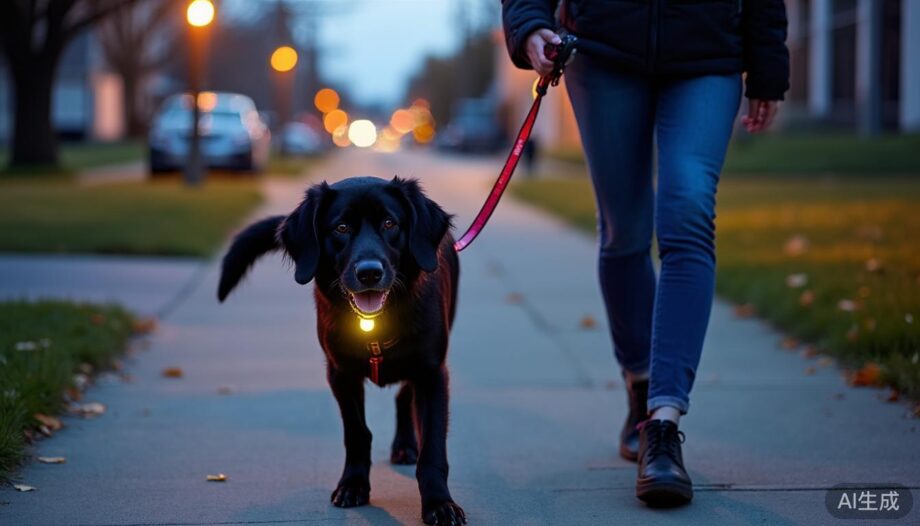
The fix is to make yourself a light source, or at least a reflector. The cheapest effective upgrade is swapping your regular leash for a reflective one — the reflective dog leash with padded handle (under $10) does double duty: the stitched reflective thread runs the full length, so the driver sees a moving line of light that reads unmistakably as “person walking a dog,” and your hand gets a padded grip for icy sidewalks.
Mistake 2: Assuming Your Dog Is Visible Because You Can See Him
You know where your dog is; a driver at 40 mph does not. Black and brown coats — which is most dogs — effectively vanish at night beyond a few dozen feet. A neon harness helps at dusk but does almost nothing in true darkness, because fluorescent colors need UV light to glow; after sundown, only retroreflective material or an actual light source works.
Two upgrades close this gap. First, a collar with reflective stitching plus a fixed ID tag — the personalized dog collar with engraved ID tag (under $10) covers both visibility and identification in one piece, and engraving cannot fall off like a hanging tag can. Second, if your dog pulls toward things in the dark, a front-clip harness gives you steering before the lunge — our dog harness fit guide explains which clip styles actually help.
Mistake 3: Relying on Your Phone Flashlight
A phone flashlight does two jobs badly. It lights only a narrow cone of pavement, leaving you and your dog invisible from the sides and behind, and it occupies your leash hand — the hand you need when a cyclist appears out of nowhere or the sidewalk ice surprises you. Its battery also dies exactly when you need it longest.
A $10–15 headlamp solves all three: both your hands stay free, the beam points where you look (curbs, dog mess, black ice), and most modern ones recharge by USB and run for a whole winter of walks. Wear it, do not clip it to the dog — a dog-mounted light bounces and blinds oncoming walkers. If you already own a clip light, the right spot is the harness back, where it works as a marker light, not your main beam.
Mistake 4: A Retractable Leash — or Off-Leash — in the Dark
Daylight logic does not transfer to darkness. A retractable leash that extends 16–26 feet gives you no reaction time when your dog reaches something you cannot yet see: a startled cat, an off-leash dog, a hole in the grass. And because you cannot read other animals’ body language at 50 feet, your dog gets into conflicts you would have defused in daylight.
The dark-walk rule is a fixed 4–6 foot leash, kept short through unlit stretches. If your dog reacts to shapes and sounds you cannot see — a very common complaint once evening walks turn dark — the reactivity usually shrinks once you add distance and a calm pivot; our guide on how to stop a dog from barking covers the counter-conditioning steps that work at night too.
Mistake 5: Autopiloting Your Summer Route
The trail that was a pleasant loop in July is a different walk in November: unlit sections hide uneven sidewalks, fallen branches, and (as the season progresses) ice and road salt. Wildlife shifts too — coyotes, foxes and deer are most active at dawn and dusk, and early darkness pushes that activity right into your walk window. Your dog hears and smells all of it long before you do; sudden stopping, staring or whining at a dark treeline is information, not stubbornness.
Rewrite the route for the season: favor lit residential streets with sidewalks, shorten the unlit park section or skip it entirely, and save exploration for weekends in daylight. As temperatures drop, paw care starts mattering too — the 15-second check in our winter dog paw care routine takes less time than tying your shoes.
Mistake 6: No Plan for “What If He Bolts?”
Darkness multiplies bolt risks: fireworks season arrives in late December, deer dart across paths, and a dropped leash at night can end with your dog gone in three seconds. A dog that escapes at 9 p.m. is dramatically harder to catch than one loose at noon — nobody can see him, and he cannot see you either.
The backup stack is cheap. Engraved ID on the collar (covered in Mistake 2) is step one. Step two is a location tag: a smart tag GPS tracker costs under $10 with no monthly fee and shows your dog’s live location on your phone. For weighing the full tracker options, our GPS dog trackers with no subscription guide compares the realistic ones.
The Under-$25 Dark-Walk Kit (and a 30-Second Pre-Walk Check)
Everything above collapses into one small kit, and none of it requires a shopping expedition:
- Reflective leash — under $10, the single highest-value swap.
- Collar with reflective stitching and engraved ID — under $10, covers visibility and escape recovery at once.
- Smart location tag — under $10, no subscription, for the bolt scenario you hope never happens.
- Headlamp — $10–15 if you do not already own one; free if you do.
- Existing jacket + $5 reflective tape — strips on each sleeve and the dog’s harness complete 360° visibility.
Before every dark walk, run the same 30-second check: light charged, phone charged, leash clipped to harness (not collar), ID readable, route chosen for lighting. The ritual matters more than any single item — it is what keeps the kit from quietly migrating to a drawer by December.
Dark Dog Walking FAQ
Is it safe to walk my dog in the dark before or after work?
Yes — with the visibility kit and a lit route, dark walks are routine for millions of working owners. The risk is not darkness itself but being invisible and unprepared in it. Fix visibility, keep the leash short in unlit areas, and shorten the walk rather than skip it; most dogs need the outlet far more than they need daylight.
What is the most visible gear color at night?
By day, neon yellow-green. After dark, color stops mattering — only retroreflective material or active lights register to drivers. White and light-gray coats have a slight edge over black, but the real difference comes from reflective stitching, tape or a clip light, which can be added to any coat or harness for a few dollars.
Should I use an LED collar or a reflective collar?
Both, ideally — they solve different problems. An LED light makes the dog visible from any direction, including where no headlights point; reflective material is far brighter in headlight beams but only when light hits it. If you buy one thing, pick reflective plus a small blinking clip light on the harness back for side streets and paths.
My dog barks and lunges at things I cannot see at night. What helps?
He is reacting to sounds and smells that are real to him and invisible to you. Close the distance to the trigger by taking the lit, boring route for a few weeks, reward calm passes generously, and treat the underlying reactivity with the counter-conditioning steps in our barking guide. Most dogs improve within two to three weeks of consistent, low-drama walks.